person
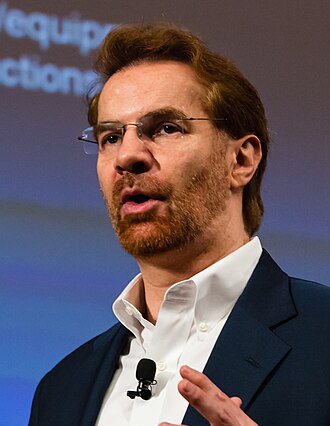
Erik Brynjolfsson
Stanford HAI; 'Turing Trap' essay
Economist who coined the 'Turing Trap', the idea that aiming AI at imitating humans, rather than augmenting them, leads to labour displacement without productivity gains. Signed the Statement on AI Risk.
Profile
expertise
External-domain expert
Recognised expert outside AI (philosophy, economics, biology, journalism) who weighs in on AI consequences from that vantage.
Stanford HAI economist. 'The Second Machine Age' (with McAfee, 2014). Long body of empirical work on AI and labour.
recognition
Field-leading
Widely known inside the AI and AI-safety community. Appears repeatedly in top venues, podcasts, or governance forums. Not a household name to outsiders.
Recurring testimony and press; less mainstream profile than Acemoglu.
vintage
Pre-deep-learning
Active before AlexNet. The existential-risk frame matures (FHI, OpenPhil, EA). Public AI commentary still rare; deep learning not yet dominant.
Race Against the Machine 2011, The Second Machine Age 2014. Pre-deep-learning labour-economics frame.
Hand-classified. See the board for the criteria and the full grid.
Strategy positions
Existential primacyendorses
Extinction/disempowerment risk overrides ordinary cost-benefitSignatory to the Statement on AI Risk.
“Mitigating the risk of extinction from AI should be a global priority alongside other societal-scale risks such as pandemics and nuclear war.”
AI skepticmixed
AGI risk narratives overstated; real harms are mundane and currentFrames the 'Turing Trap' as the economically urgent risk, not extinction but labour displacement and inequality.
We have fallen into the Turing Trap. Building AI to imitate humans concentrates power and displaces workers; building AI to augment humans does the opposite.
Closest strategy neighbours
by jaccard overlapOther people whose strategy tags overlap with Erik Brynjolfsson's. Overlap is on tag identity, not stance; opposites can show up if they reference the same tags.

Record last updated 2026-04-24.